Gemma
The Vampire Prince’s BrideGemma is the human partner of Shay and the mother of Ishoel, a figure whose intimate life becomes inseparable from questions of species, inheritance, and scientific survival. Her story moves from uncertainty about the biological boundaries between humans and Stlozyn people toward an embodied conviction that love, family, and knowledge can cross those boundaries. In the end, Gemma is not merely accepted into Shay’s world: she experiences it as home and helps make its future possible.
Identity and Cross-Species Embodiment
Gemma’s relationship with Shay places her at the center of the book’s reconsideration of what constitutes a species. Shay explains that the ancestors of the Stlozyn people were humans taken from Earth centuries earlier. Their descendants were not simply genetically modified; certain genes were intensified, additional DNA strands were added, and those changes enabled shape-shifting. The visible contrast between Shay’s scales and Gemma’s skin therefore conceals a shared ancestry rather than proving an absolute division between them.
That explanation becomes materially significant when Gemma confronts her own pregnancy. A medical scan does not present the embryo in familiar human terms. The doctor presses small nodules against Gemma’s exposed belly, producing a three-dimensional holographic image of her uterus and the developing embryo. The image looks like a disturbing combination of a tadpole and a dinosaur, yet Gemma understands that it will develop into a baby. Her response joins scientific strangeness to maternal recognition: the unfamiliar shape does not cancel the life she already perceives within it.
Love, Pregnancy, and Family
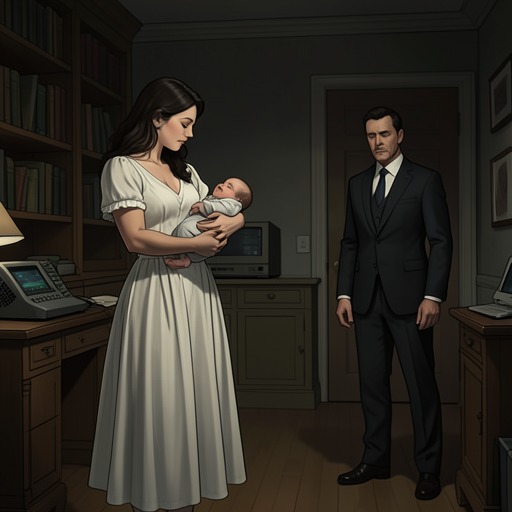
Gemma’s bond with Shay is repeatedly expressed through physical closeness, but the relationship is not reduced to desire. After Ishoel’s birth, she becomes comfortable giving Shay small amounts of blood for his research, allowing her body to support his work while he studies the biology of their people. The exchange turns domestic intimacy into scientific cooperation: Gemma’s participation gives Shay access to material that helps him pursue a cure, while their shared household provides the emotional setting in which that research continues.
Their domestic life is presented with playful familiarity as well as passion. While Ishoel naps in their apartment, Shay watches a holographic simulation resembling DNA. When he suddenly realizes that his research has succeeded, he leaps from the sofa and performs an awkward dance in robes that flap around him, prompting Gemma to suppress a laugh. Her amusement is important because it shows their relationship outside crisis and laboratory seriousness. The dragon who is a researcher and healer can also look ridiculous to the woman who loves him, and that ordinary intimacy makes their extraordinary household feel lived in.
Gemma’s pregnancy and motherhood also establish her as an active participant in the future of the Stlozyn community rather than a passive vessel for it. Her body links human and Stlozyn inheritance, while her decisions and support help turn that potentially frightening difference into kinship. The child, Ishoel, becomes evidence that the two populations are biologically compatible, and Gemma’s presence gives that scientific fact a personal and emotional form.
Science, Cure, and Shared Achievement
Shay’s research eventually demonstrates that the Stlozyn infertility disease can be reversed. Simulated DNA works as effectively as harvested human DNA, meaning the cure does not require the dangerous or ethically troubling extraction of human genetic material from Earth. Gemma responds with immediate pride, recognizing that Shay has cured his people. Her reaction frames the achievement as both his accomplishment and a victory made possible through their partnership.
Shay accepts a position on the Science Board because he has earned it through this work, but he explicitly credits Gemma, saying he could not have done it without her. The acknowledgment gives her contribution a status beyond emotional encouragement. She has provided blood, endured invasive scans, carried and raised their child, and remained beside Shay while he pursued a solution to a communal crisis. The cure therefore emerges from a network of bodies and relationships rather than from detached scientific brilliance alone.
The scene also reverses the initial direction of knowledge between them. Shay first explains his people’s genetic history and the mechanism of shape-shifting to Gemma. Later, Gemma’s body and participation become part of the evidence through which the future of those people is secured. She moves from someone confronted by an unfamiliar embryo and unfamiliar biology to someone whose own life helps establish that the supposed species boundary is permeable.
Relationships and Belonging
Gemma and Shay’s relationship is grounded in mutual declaration. Shay confesses that he has waited a long time to tell someone that he loves her, and Gemma answers that she loves him too. Their exchange is followed not by a public ceremony or political proclamation but by the quiet image of the couple holding one another with their eyes closed, reveling in the warmth of being together and of being home.
That sense of home is the decisive emotional conclusion of Gemma’s arc. She understands that home is not defined by Earth, by human appearance, or by the absence of biological difference. It is located in Shay’s arms, in the family they have created, and in the shared future their work protects. Her acceptance is not surrender to an alien world; it is a chosen belonging within a mixed family and a wider community whose survival has been transformed by their partnership.
Gemma also participates in the story’s broader pattern of boundaries being crossed through embodied relationships. Her pregnancy joins human and Stlozyn lineages, while Shay’s dragon identity remains part of the person she loves rather than a barrier she must erase. Their intimacy does not eliminate difference. Instead, it makes difference compatible with attachment, parenthood, research, and social renewal.
Change and Narrative Significance
Gemma’s trajectory changes the meaning of the unfamiliar. The embryo that first appears frighteningly unlike a human baby becomes the child she and Shay raise. Shay’s scales, initially part of the biological explanation separating Stlozyn people from humans, become part of the body she touches and embraces. Even the technological world surrounding her, including holographic medical imaging and DNA simulations, shifts from alien spectacle into the practical environment of her family’s life.
Her significance lies in the way the narrative gives scientific and political transformation an intimate anchor. The cure for the Stlozyn infertility disease matters because it preserves a people, but Gemma’s involvement shows what preservation looks like at the level of a household: blood offered for research, a child sleeping nearby, a partner celebrating in ridiculous robes, and two people affirming love after surviving the strangeness of their own bodies. Gemma’s final position is therefore both personal and historical. She is Shay’s beloved, Ishoel’s mother, a human participant in Stlozyn scientific renewal, and the person who can honestly say through her actions that she has found home across a boundary that once seemed absolute.